What does a radiologic technologist do day to day?
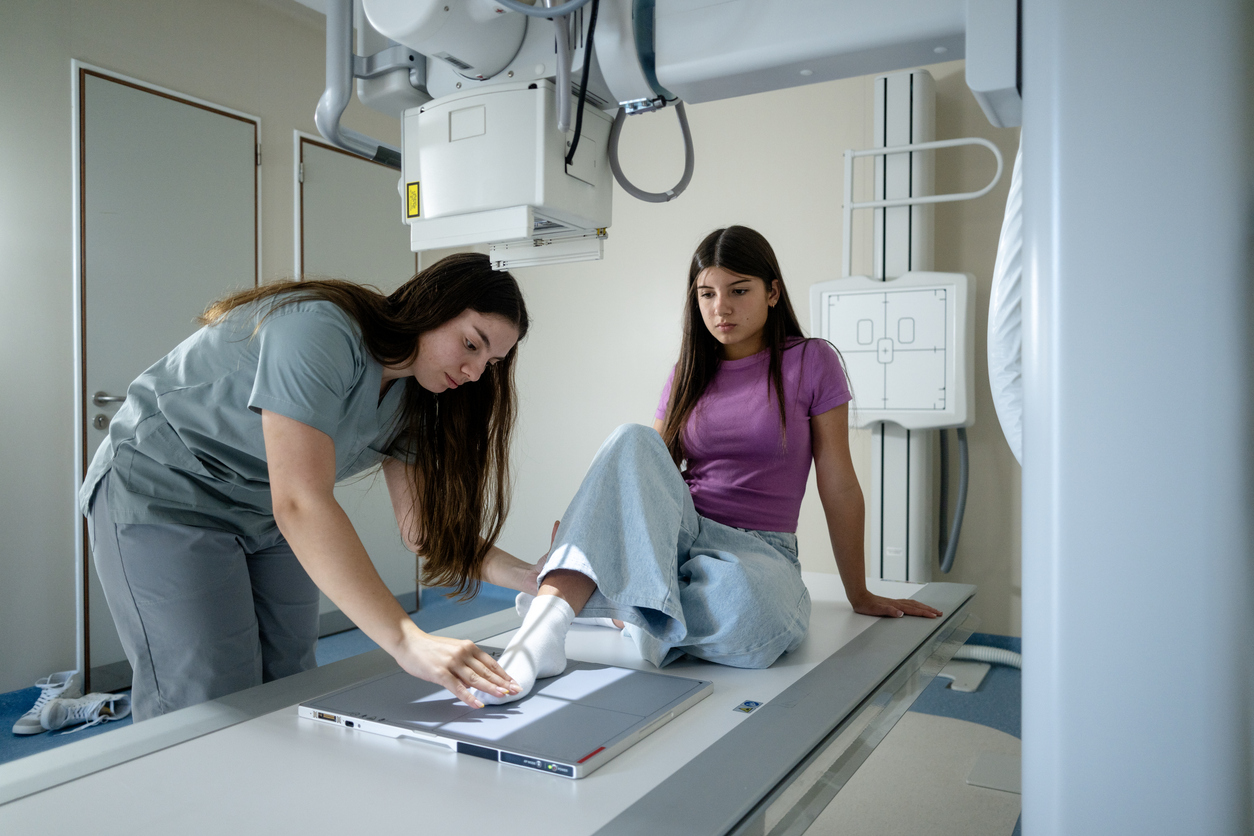
If you have ever had an X-ray after a fall or a sports injury, you have met a rad tech. The radiologist is the physician who interprets the image. The rad tech is the one in the room with you, making sure that image is right the first time.
A typical shift looks something like this:
- Reviewing orders. Every exam starts with a physician’s order specifying exactly which part of the body to image. Rad techs follow those orders precisely.
- Preparing the patient. That means confirming identity, taking a brief history, explaining the procedure, and shielding areas that do not need to be imaged.
- Positioning. This is where skill shows. Getting a clean image of a shoulder, a spine, or a broken wrist depends on angling the patient and the equipment correctly, often while the patient is in pain.
- Running the equipment. Rad techs operate computerized imaging systems and set the technical factors that control image quality and radiation dose.
- Checking the image. They evaluate each image and work with the radiologist to decide whether more views are needed.
- Documenting. Every exam gets a detailed patient record.
According to the U.S. Bureau of Labor Statistics, about 60% of rad techs work in hospitals, with the rest in physician offices, imaging centers and labs. The work is physical. You are on your feet most of the shift and regularly help lift or turn patients. Because imaging is needed around the clock, hospital roles can include evenings, weekends or overnights.
And yes, radiation safety is part of the job every day. Rad techs wear badges that track their exposure, keep a record of their cumulative lifetime dose, and use lead aprons and shielding to keep that exposure low.
Many rad techs also branch into specialties after their first credential, including CT, mammography and MRI.
Is radiologic technology a 2-year or 4-year program?
Two years is the standard route. An associate degree is the typical entry-level education for rad techs, and it is also the minimum the profession requires. Since January 1, 2015, the American Registry of Radiologic Technologists (ARRT) has required candidates to hold at least an associate degree before they can sit for the certification exam.
A bachelor’s degree is optional. It can help later if you want to move into management, education or an advanced role like radiologist assistant, but you do not need one to get hired as a rad tech.
At Parker, the Associate of Applied Science in Radiologic Technology is a 74-credit program that takes about two years total. Students complete general education courses first, then apply to the 16-month RT major: roughly 10 months of evening classes on campus followed by 6 months of clinical rotations at healthcare sites across Dallas-Fort Worth.
Do I need ARRT certification to work as a rad tech?
In Texas, effectively yes. Texas requires anyone performing radiologic procedures to hold a state certificate or be on the state’s registry. To qualify for the General Medical Radiologic Technologist (MRT) certificate, the Texas Administrative Code requires current ARRT certification as a registered technologist in radiography (or one of a few related credentials). So in practice, the path to working as a full-scope rad tech in Texas runs through the ARRT.
Earning ARRT certification takes three things:
- Education. Complete an ARRT-recognized radiography program and earn at least an associate degree.
- Ethics. Meet the ARRT’s ethics requirements. If you have something in your background you are worried about, ARRT offers an ethics review you can request before you finish your program.
- Exam. Pass the ARRT radiography exam. Once you do, you can use the credential RT(R).
Rules vary by state, and a handful of states do not license rad techs at all. Even there, BLS notes that employers typically require or prefer certified technologists, so ARRT certification is the credential worth planning around wherever you end up working.
What's the difference between a rad tech and an MRI tech?
The biggest difference is the technology. Rad techs use ionizing radiation to create X-ray and CT images. MRI techs use powerful magnets and radio waves, with no radiation involved. That changes the safety work completely: rad techs manage radiation dose, while MRI techs screen every patient for metal implants and devices that could react to the magnet.
| Radiologic Technologist | MRI Technologist | |
|---|---|---|
| Imaging Method | X-ray, often CT | Magnetic resonance |
| Typical Entry Education | Associate degree | Associate degree, often plus rad tech experience |
| Median pay, May 2025 | $80,110 | $95,480 |
| Projected growth, 2025 to 2035 | 5% | 8% |
| Jobs in 2025 | 234,200 | 43,900 |
Source: U.S. Bureau of Labor Statistics
Here is the part most comparisons leave out: many MRI techs start as rad techs. BLS notes that MRI technologists typically need some related work experience, most often as a radiologic technologist. The ARRT also lets credentialed technologists add MRI through a post-primary pathway built on clinical experience. So for a lot of people, rad tech is not the alternative to MRI. It is the first step toward it.
Is rad tech harder than nursing?
Neither is easier. They are hard in different ways, and the better question is which kind of hard suits you.
Nursing is broad. Nurses manage the whole patient across a shift: medications, assessments, care plans, family communication and constant prioritization across several patients at once. Nursing students carry heavy clinical loads and then sit for the NCLEX licensing exam.
Radiologic technology is deep. The scope is narrower, but the precision required is high. Students learn radiation physics, detailed anatomy, positioning for dozens of exams, image evaluation and radiation protection, and they have to pass the ARRT exam before they can work. Patient interactions are shorter but frequent, and you need to put a nervous or injured person at ease quickly to get a usable image.
A few honest questions can help you decide:
- Do you like technology and technical precision, or ongoing patient relationships? Rad tech leans toward the first, nursing toward the second.
- Are you comfortable with math and physics? Rad tech coursework has more of it.
- Do you want a focused skill set you can specialize from (CT, MRI, mammography), or a broad clinical role with many directions? Both have strong career ladders.
If you are still unsure, shadowing in an imaging department for a day will tell you more than any blog post can.
How much do radiologic technologists make?
The median annual wage for radiologic technologists was $80,110 in May 2025, according to BLS. That is well above the $50,980 median for all U.S. workers. The lowest 10% earned less than $55,980, and the top 10% earned more than $118,660.
Where you work makes a real difference:
| Work Setting | Median Annual Wage, May 2025 |
|---|---|
| Federal Government | $97,490 |
| Outpatient Care Centers | $84,720 |
| Hospitals (state, local, and private) | $80,650 |
| Medical and Diagnostic Laboratories | $78,400 |
| Physician Offices | $74,540 |
Source: U.S. Bureau of Labor Statistics
New graduates should expect to start below the median and climb with experience. Adding a second credential is one of the most reliable ways to raise your pay. MRI technologists, for example, earned a median of $95,480 in the same BLS data.
What's the job outlook for rad techs in Dallas-Fort Worth?
Texas is growing much faster than the country. Nationally, BLS projects rad tech and MRI tech employment to grow 5% from 2025 to 2035, with about 15,300 openings a year. Texas projections are far stronger: rad tech jobs in the state are expected to grow 18% from 2024 to 2034, from 18,990 to 22,360, with about 1,390 openings every year.
Dallas-Fort Worth is home to major hospital systems, freestanding emergency centers and outpatient imaging centers spread across the Metroplex. That density matters for new graduates. More facilities mean more clinical sites while you train and more employers to choose from once you are certified.
The drivers behind that growth are not going away. BLS points to an aging population and rising rates of chronic disease, which mean more falls, more fractures and more cancer screening, all of which require imaging.
Will AI replace radiologic technologists?
It is a fair question, and the evidence so far points the other way. AI tools in radiology are mostly built to help read images. A rad tech’s core work is acquiring them: positioning a patient in pain, adjusting for a body that does not fit a textbook, and keeping radiation dose as low as possible. That is hands-on work at the bedside.
Demand for imaging is also rising, not falling. In October 2026, researchers at the Harvey L. Neiman Health Policy Institute pushed back on claims that AI has reduced the need for imaging professionals, pointing to their projection that U.S. imaging use will grow 17% to 27% by 2055 and to rising CT and MRI volumes in Medicare data since 2016. The more likely future is rad techs working alongside AI tools, not being replaced by them.
How does Parker's Radiologic Technology program work?
Parker’s Associate of Applied Science in Radiologic Technology is built for people who want to get into imaging without putting the rest of their life on hold.
- Evening classes on our Dallas campus, so you can keep working or manage family commitments while you train.
- Six months of clinical rotations at healthcare sites across Dallas-Fort Worth, using the same equipment working technologists use.
- Small classes with personal attention from faculty.
- 74 credit hours that meet the industry standard for entry into the profession, with graduates eligible to sit for the ARRT exam.
The program is designed for both first-time college students and career changers. To move into the RT major, students complete their general education courses with a cumulative GPA of 3.0, score 75 or higher on the HESI entrance exam, and apply two months before the major starts. You can review the full admissions requirements here.
Ready to see if rad tech is the right fit? Request information or schedule a campus visit to see the campus and meet the faculty.
Questions people are asking
Is radiologic technology a good career? For many people, yes. It pays a median of $80,110 nationally with a two-year degree, Texas projects 18% job growth over the next decade, and there is a clear ladder into higher-paying specialties like CT and MRI.
How long does it take to become a rad tech? About two years for an associate degree, plus time to take the ARRT exam and apply for your state certificate. At Parker, the RT major itself runs 16 months after general education courses.
Can I work while I’m in rad tech school? Many students do during the classroom portion, especially in evening programs like Parker’s. Clinical rotations are more demanding on your schedule, so plan for less flexibility during those six months.
What’s the difference between a radiologic technologist and a radiologist? A radiologist is a physician who completed medical school and residency and interprets imaging to make a diagnosis. A radiologic technologist performs the imaging exam and captures the images the radiologist reads.
Can rad techs do CT scans? Yes. Radiologic technologists specialize in X-ray and CT imaging, and many add a CT credential through the ARRT after gaining experience.
Is the radiation exposure dangerous for rad techs? The hazard is real but well controlled. Rad techs wear monitoring badges, track their lifetime dose, and use lead aprons, gloves and shielding to keep exposure low.
Do I need to be good at math and science? You need to be comfortable with them. Coursework includes anatomy, radiation physics and calculations for setting exposure, so solid high school math and science will help.