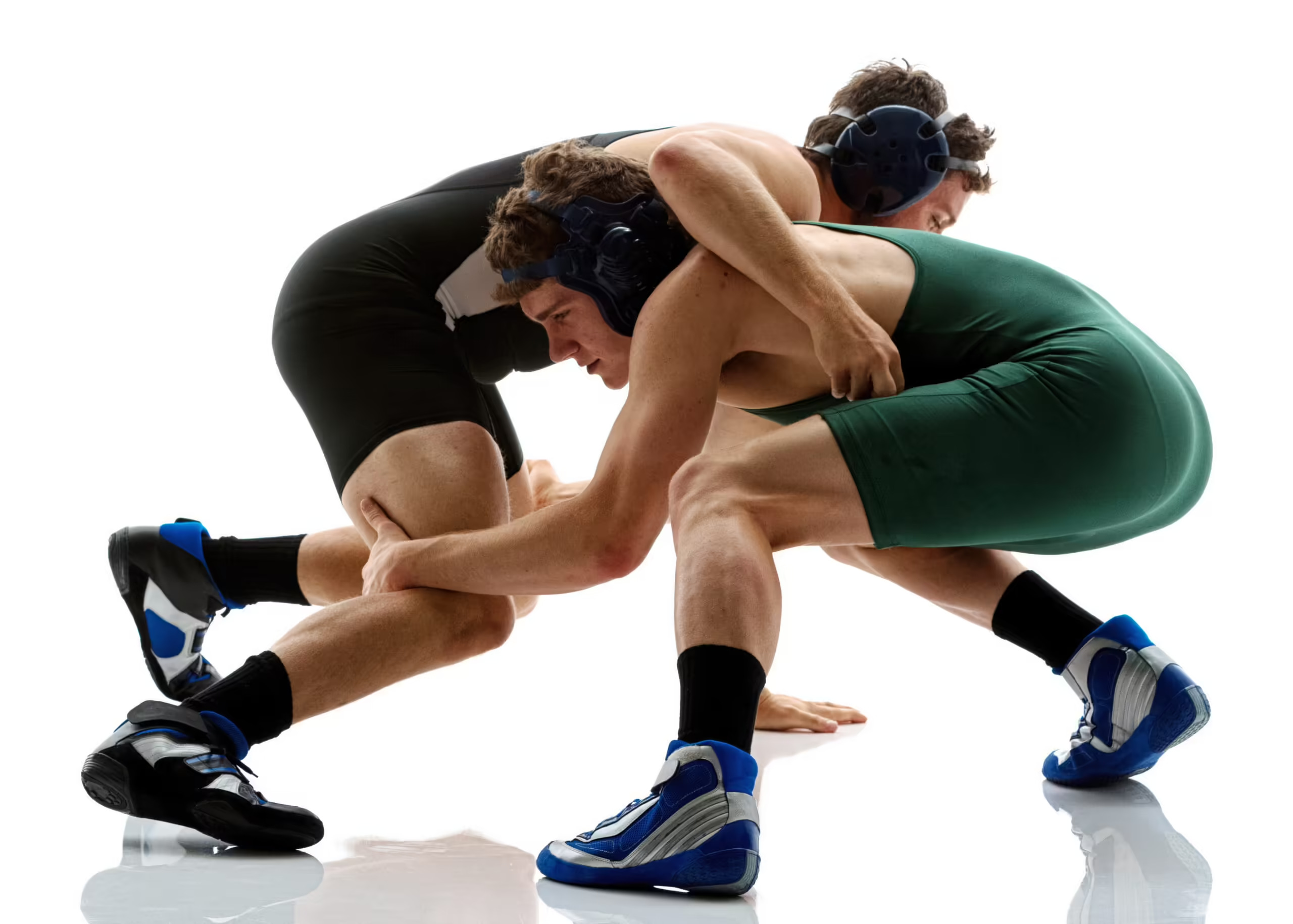
Wrestling is one of the few sports where you step onto the mat completely alone. Your weight, your record, and your mistakes are all on display. That pressure is the backdrop for new research published in The Sport Journal by Parker faculty Scott McDoniel, Collin Fehr, and Jenna Romanelli.
Their questions were straightforward. Can we reliably measure how mentally flexible young wrestlers are? And who struggles the most? The answers matter for coaches, parents, and anyone who wants a career working with athletes.
What Is Psychological Flexibility in Sport?
Psychological flexibility is the ability to notice difficult thoughts and feelings (nerves, doubt, frustration after a loss) without letting them take over, and to keep doing what matters anyway. A flexible athlete can feel anxious before a match and still wrestle their game plan. An inflexible athlete gets stuck trying to push the anxiety away, and that struggle becomes the focus.
The concept comes from Acceptance and Commitment Therapy (ACT), a well-established approach in psychology. In sport, it shows up as three practical skills:
- Staying present: attention on this match, this position, this moment
- Cognitive defusion: treating a thought like “I’m going to lose” as a thought, not a fact
- Committed action: acting on your goals and values even when it’s uncomfortable
What Did the Parker Study Look At?
The research team surveyed 157 competitive wrestlers ages 13 to 18 from seven states: Arkansas, Georgia, Kansas, Missouri, New Mexico, Oklahoma, and Texas. About 72% were male and 28% were female. Each wrestler completed established questionnaires measuring psychological flexibility, sport anxiety, shame, and resilience.
The PFSS had never been tested with adolescent wrestlers. So the first job was validation, confirming the scale measures what it claims to measure in this group. The study was approved by Parker University’s Institutional Review Board, and all responses were anonymous.
What Did the Researchers Find?
- The PFSS works for teen wrestlers. The scale showed good reliability (Cronbach’s alpha of .83) and held together as a single measure. In practical terms, coaches and practitioners can use it as a quick screening tool.
- Inflexibility travels with anxiety. Wrestlers who scored higher in inflexibility reported much more sport anxiety, including physical nerves, worry, and trouble concentrating. This was the strongest relationship in the study (r = .62).
- It’s tied to shame and lower resilience. More inflexible wrestlers were more worried about how others judged them and less able to bounce back from setbacks.
- Years two and three are the peak. Inflexibility was lower for first-year wrestlers, highest for those in their second and third years, and lower again for veterans with four or more years.
- Female wrestlers scored higher on average. Girls in the study reported more inflexibility, anxiety, and shame, and lower resilience, than boys.
- More training hours didn’t change it. Time spent training had no meaningful relationship with psychological flexibility, even after accounting for years of experience.
Here’s how average PFSS scores broke down by experience and gender. Higher scores mean more inflexibility.
| Experience Level | Male Wrestlers | Female Wrestlers |
|---|---|---|
| Novice (1st year) | 22.4 | 24.4 |
| Intermediate (2nd to 3rd year) | 25.3 | 31.2 |
| Veteran (4+ years) | 22.6 | 28.0 |
Why Are the Second and Third Years the Hardest?
The authors describe this stretch as a “risk window.” First-year wrestlers are still learning, and expectations are low. By year two, things change. Athletes have a record, coaches expect more, and comparisons with teammates and opponents get sharper.
The researchers point to a rebound effect. Trying hard to suppress worry tends to keep attention locked on it. Add how sensitive teenagers are to judgment from peers and coaches, and it’s easy to see how shame enters the picture.
The authors also flag this window as a likely point where athletes drop out of the sport. Veterans who stay appear to have worked through it, though this study captured a single point in time, so it can’t say whether they built better coping skills or the athletes who struggled most simply left.
What Does This Mean for Coaches, Parents, and Athletes?
Mental skills deserve the same planning as physical ones. Based on their findings, the authors recommend:
- Screen early. The PFSS takes a few minutes and can flag athletes at risk for worry and shame.
- Time support around the transition. Focus on athletes moving from year one into years two and three, not only beginners.
- Train the mind directly. Since more mat time didn’t improve flexibility, build in mindfulness and ACT-based skills: staying present, defusion, and committed action.
- Track it across a season. Re-administer the PFSS to see whether changes hold.
- Pay attention to female wrestlers, who scored higher on average in this sample.
A note on limits: the study is cross-sectional, so it shows relationships, not cause and effect. Only eight veteran female wrestlers participated, so gender findings at that level should be read with caution. All data was self-reported.
Where This Research Connects to a Parker Degree
This study sits right where two of Parker’s fully online bachelor’s programs meet: how athletes think and how they train.
- Bachelor of Science in Sport Psychology: Explores the connection between the mind and athletic performance, combining psychological theory, research, and practical coaching and counseling skills with courses in exercise physiology, biomechanics, and injury rehabilitation. It’s a strong foundation for graduate study in sport psychology or for careers in coaching, education, and health promotion.
- Bachelor of Science in Strength and Human Performance: Prepares you for careers in personal training, coaching, and athletic performance, and builds a foundation for graduate programs in physical therapy, sports medicine, or chiropractic.
Already have a bachelor’s degree? The online Master of Science in Strength and Human Performance goes deeper into exercise physiology, biomechanics, motor learning, and strength and conditioning.
In all three programs, you learn from faculty who are actively publishing research on real athletes, including the authors of this study.
Meet the Researchers
- Scott McDoniel, Assistant Professor, Strength & Human Performance, Parker University (corresponding author)
- Collin Fehr, Adjunct Instructor, Parker University
- Jenna Romanelli, Program Director, Strength & Human Performance, Parker University
Ready to Study the Science of Performance?
If you want to understand how athletes think, train, and compete, explore Parker’s online Sport Psychology and Strength and Human Performance programs, or talk with an admissions advisor about which path fits your goals.
Source: McDoniel, S., Fehr, C., & Romanelli, J. (2026, November 11). Psychological flexibility in U.S. adolescent wrestlers: Scale validation and the influence of gender and experience. The Sport Journal.