To become an EKG technician, you complete a short training program, practice on real patients, and pass a national certification exam. Most people finish in a few months, and you don’t need a college degree to start.
EKG Technician at a glance:
| Question | Short Answer |
|---|---|
| How long does training take? | Weeks to months. Parker’s program is two 26-day courses, about 2 months total. |
| Do I need a degree? | No. A high school diploma or GED is the usual starting point. |
| Do I need to be certified? | It’s usually not a legal requirement, but most employers want it. The most common credential is the NHA Certified EKG Technician (CET). |
| What does it pay? | About $19 to $25 an hour in job-posting data, or roughly $40,000 to $52,000 a year full time. |
| Where do EKG techs work? | Mostly hospitals, plus physician offices, outpatient clinics, and diagnostic labs. |
| Can I train while working? | Often, yes. Parker’s program is online except for one Saturday lab. |
What does an EKG technician do?
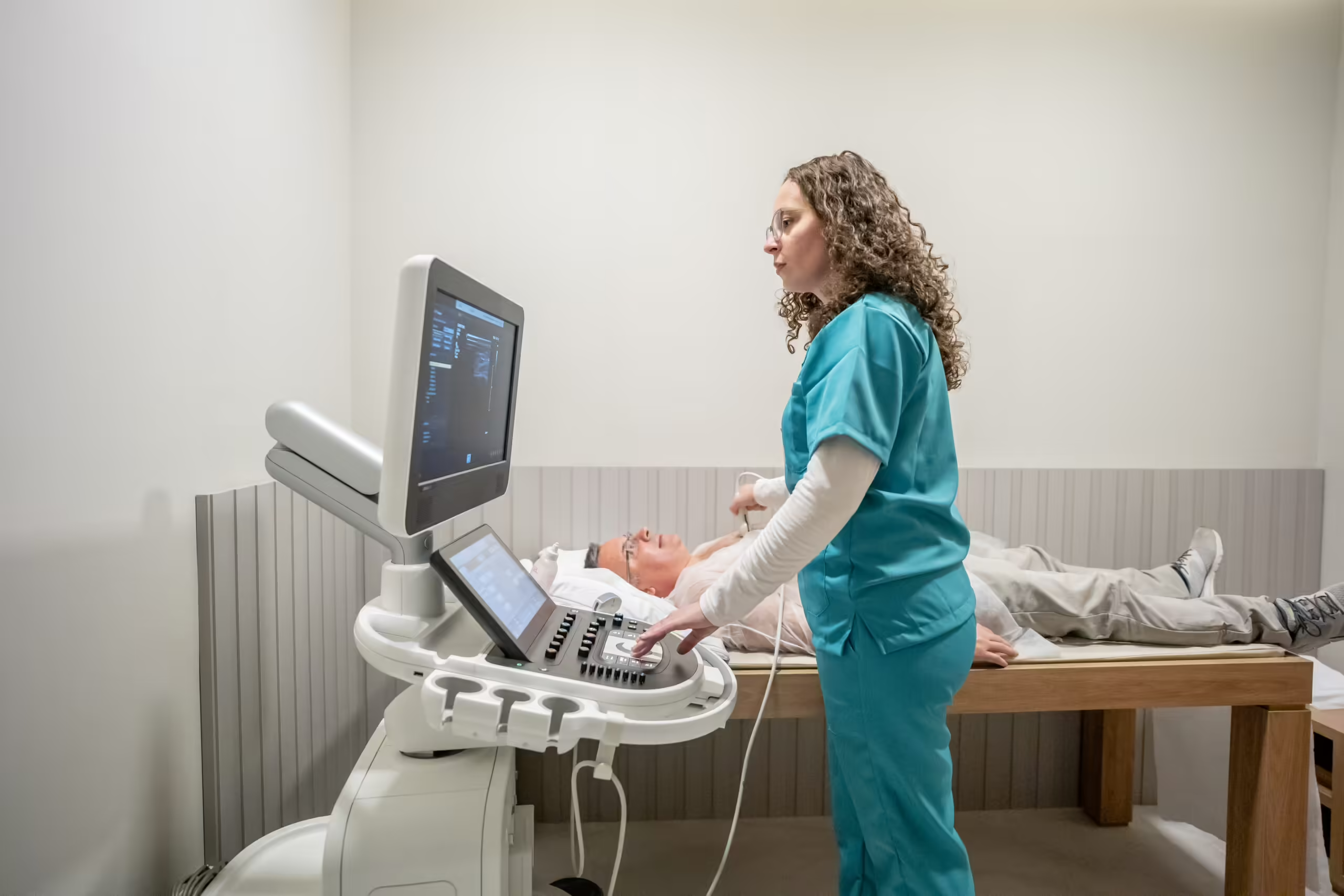
An EKG technician records the electrical activity of a patient’s heart so a physician can read it. You place electrodes on the chest, arms, and legs, run the test, check that the tracing is clean, and get it to the provider.
A typical day might include:
- Running 12-lead EKGs in the emergency department, on hospital floors, or before surgery
- Setting up Holter monitors that patients wear for a day or more at home
- Helping with cardiac stress tests while a patient walks on a treadmill
- Spotting problem tracings and flagging anything urgent to a nurse or physician
- Explaining the test to patients who are often nervous about their heart
That last one matters more than people expect. You’ll spend a lot of your day with someone who just heard the word “cardiac.” Calm, clear communication is part of the job.
The Bureau of Labor Statistics groups EKG technicians with cardiovascular technologists, who held about 64,500 jobs in 2025. About 77% of those jobs were in hospitals. Hospitals run around the clock, so evening, weekend, and overnight shifts are common.
How do you become an EKG technician? 5 steps
Step 1: Meet the basic requirements. Most programs and certification bodies expect a high school diploma or GED. Some also require you to be 18 and hold CPR or Basic Life Support (BLS) certification.
Step 2: Complete an EKG training program. A good program covers heart anatomy, lead placement, rhythm recognition, and patient safety, with lab time on real equipment. The BLS notes that EKG certificate programs generally take less than a year.
Step 3: Get hands-on practice with live patients. The National Healthcareer Association (NHA) requires proof of at least 10 EKGs performed on live people for full CET certification. Practicing on a mannequin isn’t enough.
Step 4: Pass a certification exam. The NHA CET exam has 120 multiple-choice questions (100 scored) and a two-hour time limit. It covers safety and compliance, EKG acquisition, and EKG analysis. Other employers accept the Certified Cardiographic Technician (CCT) credential from Cardiovascular Credentialing International (CCI).
Step 5: Apply for jobs and keep your credential current. NHA certification renews every two years with continuing education. Hospital job postings often list “EKG tech” alongside titles like cardiac technician or ECG technician, so search all three.
One note on spelling: EKG and ECG mean the same thing. EKG comes from the German elektrokardiogramm, and many U.S. hospitals still use it to avoid confusion with EEG, a brain test.
How long does it take to become an EKG technician?
Most people can go from day one of training to certified in two to four months. Training itself ranges from a few weeks to a full semester depending on the program. Parker’s EKG technician training is two 26-day courses, about two months total.
After training, add time to schedule and sit for the certification exam. The NHA lets you test online with a remote proctor or at a testing center, which keeps that gap short.
Compare that with other entry points into healthcare. Radiologic technology and sonography typically take about two years. Nursing takes two to four. An EKG certificate is one of the fastest ways to start working in a clinical setting.
How much do EKG technicians make?
Entry-level EKG technicians in the U.S. typically earn about $19 to $25 an hour. Full time, that works out to roughly $40,000 to $52,000 a year.
Those figures come from job-posting and salary-report data, as of mid-2026:
| Source | Average pay for EKG Technicians |
|---|---|
| Indeed (job postings, updated July 2026) | About $25 an hour |
| ZipRecruiter (September 2026) | About $24 an hour, or $49,700 a year |
| Payscale (2026) | About $19 an hour, with a range of $15 to $27 |
You may also see a much higher number: $74,310. That’s the BLS median for the full cardiovascular technologists and technicians category (May 2025). It includes cardiac cath lab specialists, who assist with invasive heart procedures and need more training. EKG technicians usually start below that median.
Pay climbs with experience, location, and added skills. Techs who also handle Holter scanning, stress testing, or rhythm monitoring tend to earn more, and so do those who work night shifts.
What's the difference between an EKG tech and a monitor tech?
An EKG technician performs heart tests at the patient’s side. A monitor technician, also called a telemetry tech, watches heart rhythms on screens for many patients at once and alerts nurses when something changes.
The two jobs share a foundation. Both depend on knowing what a normal rhythm looks like and catching one that isn’t. Many people start as EKG techs and move into monitoring, or do both on the same hospital team. If you like being on your feet with patients, EKG work is the better fit. If you’d rather focus on the screen, monitoring might suit you.
Can you train to be an EKG tech while working another job?
Yes, in many cases. EKG training is short, and programs that put the coursework online let you study around your work hours. The in-person piece, where you practice on equipment and real people, is what you’ll need to plan around.
Before you enroll anywhere, ask three questions:
- When do the in-person sessions meet: weekdays, evenings, or weekends?
- How many hours a week should I plan for, including study time?
- How are the live-patient EKGs arranged, and when?
At Parker, the program is completely online except for one Saturday lab on campus in Dallas, where you train in CPR, practice hands-on EKG skills, and complete your live-patient EKGs. For most working adults, that means finishing without taking time off.
Once you’re certified, the job itself is friendly to a second schedule. BLS notes that part-time work is common in this field, and hospitals hire for every shift. That makes EKG work a common stepping stone for students paying their way through a longer healthcare program.
Is becoming an EKG technician worth it?
For the right person, yes. You can be working in a hospital within a few months, for far less time and tuition than a degree program. The trade-off is that EKG tech is an entry-level role, and the pay reflects that.
BLS projects 4% employment growth for cardiovascular technologists and technicians from 2025 to 2035, about as fast as average, with roughly 3,400 openings a year. An aging population and more heart disease keep demand for cardiac testing steady. That’s stable, not explosive.
EKG tech is a strong fit if you:
- Want to start working in healthcare in months, not years
- Are changing careers and can’t stop earning for two to four years
- Want to test whether patient care suits you before committing to a longer program
- Are detail-oriented and stay calm with anxious people
- Are open to evening, weekend, or overnight shifts
Think of it as a first step. The biggest value of an EKG credential is often where it leads. Hospital experience and rhythm skills carry into cardiac monitoring, cardiovascular sonography, and other clinical roles. Parker offers an Associate of Applied Science in Diagnostic Cardiovascular Sonography for anyone who wants to move further into cardiac care later.
How does Parker University's EKG technician training work?
Parker’s Electrocardiograph Technician Training is a focused program of two 26-day courses, about two months total. It’s completely online except for one Saturday lab on our Dallas campus, where you train in CPR and hands-on EKG skills and complete the live-patient EKGs NHA requires for full certification.
What to expect:
- One course at a time. The curriculum is built so you master one subject before moving to the next.
- Small classes. Enrollment is limited so instructors can give you individual attention.
- Real equipment. You train on the same tools EKG techs use on the job, and CPR instruction is part of the program.
- Certification prep. The program prepares you to sit for the National Healthcareer Association (NHA) Certified EKG Technician (CET) exam, and the exam fee is included in the program cost.
- Support after you finish. [CONFIRM still current: free continuing education through Parker Seminars, plus job placement and resume help.]
Parker is accredited by the Southern Association of Colleges and Schools Commission on Colleges (SACSCOC). That’s the same regional accreditation that covers our associate, bachelor’s, master’s, and doctoral programs, so if your EKG certificate is the first step, you’re already at a university with somewhere to go next.
Ready to start? Explore the Electrocardiograph Technician Training program or request information to talk with admissions about prerequisites, tuition, and the next start date.
Other questions people ask
Is the EKG certification exam hard?
It’s built for entry-level candidates who have finished training. The NHA CET exam has 120 questions (100 scored) in two hours. The toughest part for most students is rhythm recognition, so practice reading strips until it feels automatic.
Can EKG technicians read or diagnose EKGs?
No. EKG techs record the test and flag tracings that look urgent. A physician interprets the results and makes the diagnosis.
Is being an EKG tech stressful?
It can be. You may run an EKG in the emergency department while a patient is having chest pain. Most days are steady and routine, but you need to stay focused when things move fast.
Can I become an EKG technician entirely online?
Not completely. The coursework can be online, but you need hands-on practice and live-patient EKGs to earn full NHA certification. At Parker, that in-person requirement is a single Saturday lab.
What’s the difference between an EKG tech and a cardiovascular technologist?
Cardiovascular technologist is a broader title. It often refers to cath lab specialists who assist with invasive procedures and usually need an associate degree. EKG technician is the entry-level, noninvasive side of the same field.