What did the AMTA report find?
In September, AMTA released its 2026 Massage Therapy in Integrative Care and Pain Management report. As part of it, the economic research firm John Dunham & Associates modeled what would happen if public and private insurance covered massage therapy more broadly. Their estimates:
- $11.1 billion in annual net healthcare savings nationwide
- $4 billion of that in Medicare and Medicaid savings
- $7.1 billion in savings for private insurers and people paying out of pocket
- Up to 96,000 additional massage therapists entering the healthcare marketplace over time
The report is clear that massage isn’t meant to replace medical treatment. It frames massage as one part of a coordinated care plan, working alongside physicians, rehabilitation specialists, and medication for people managing chronic pain, injury recovery, or long-term conditions.
Why does insurance coverage matter so much?
Because right now, cost is the barrier. Massage therapy already shows up in hospitals, rehab centers, and medical practices, but insurance coverage is inconsistent. Most patients either pay out of pocket or go without. The report’s central argument is that removing that financial barrier would give more people another option for managing pain, and the savings would follow from there.
How seriously should you take the $11.1 billion figure?
Seriously, but carefully. This is a model built on assumptions about how expanded coverage would change patient behavior, and it was commissioned by the profession’s own national association. That doesn’t make it wrong. It does make it a direction worth watching rather than a number to bank on.
Greg May, Program Director of Massage Therapy at Parker University, put it this way:
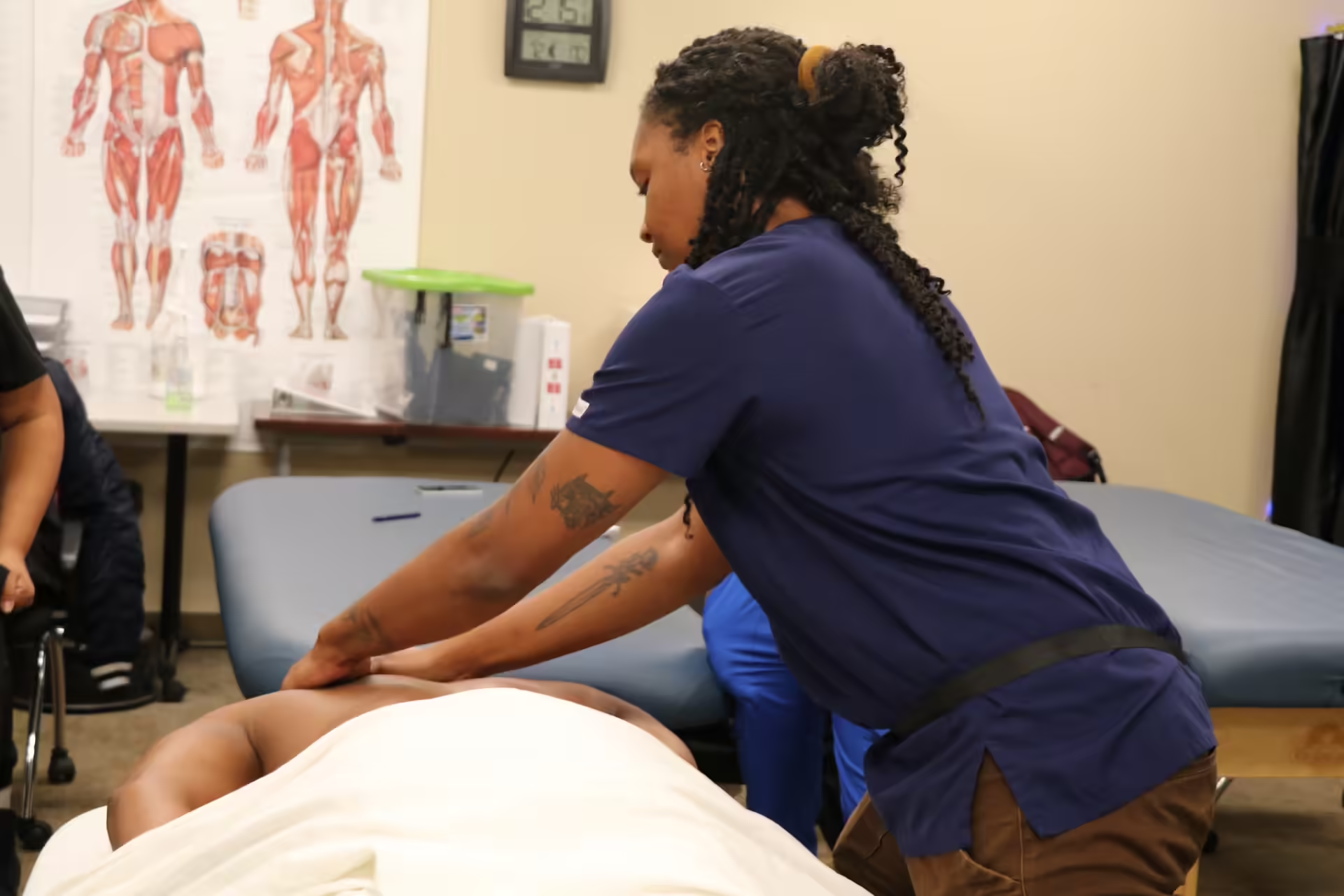
“AMTA’s report highlights an important opportunity: expanding access to massage therapy could help more people manage pain while potentially reducing healthcare costs. At Parker University School of Massage Therapy, our curriculum supports that vision by combining anatomy, physiology, pathology, and applied kinesiology with neuromuscular therapy, myofascial therapy, and supervised clinical experience. These foundations help students connect their hands-on skills with an understanding of the human body and each client’s needs. While the projected $11.1 billion in annual savings represents a possibility rather than a guaranteed outcome, the report reinforces the importance of preparing knowledgeable, ethical massage therapists who can contribute to integrative, patient-centered care.”
What does this mean for future massage therapists?
The demand is already there. The Bureau of Labor Statistics projects massage therapist jobs will grow 15% from 2024 to 2034, much faster than the average for all occupations, with a median annual wage of $57,950 (May 2024).
If coverage expands, more of that work moves into clinical settings, where therapists collaborate with other providers and treat patients with real medical histories. That’s where a science-grounded education matters. Technique gets you in the door. Understanding the body, the condition, and the person on the table is what makes you part of the care team.
Questions People Are Asking
Does insurance cover massage therapy? Sometimes. Coverage varies widely by plan, and many patients currently pay out of pocket. That gap is exactly what the AMTA report focuses on.
Is massage therapy a growing career? Yes. BLS projects 15% job growth from 2024 to 2034, adding roughly 25,900 jobs.
Where can I train as a massage therapist in Dallas? Parker University School of Massage Therapy offers a 600-hour, COMTA-accredited Massage Therapy Certificate on our Dallas campus, with hands-on training in our on-campus clinic and preparation for licensure. Learn more about the program.